Most oral surgeons can recall the familiar, frustrating post-GBR scenario: a barrier membrane that looked perfectly positioned at the end of surgery, early soft tissue exposure at the 2-week follow-up, insufficient bone gain at the 4-month re-entry, or a patient who requires repeat grafting to achieve the planned implant site. In almost every case, the clinical conversation defaults to familiar explanations: the surgeon’s flap design was too tight, the membrane was too thin, the patient had poor oral hygiene, or the graft material was low quality. Rarely does the discussion turn to the smallest, cheapest component holding the whole procedure together: the titanium bone tack securing the membrane. For clinics running high GBR case volumes, the quiet, underrecognized source of many of these failures may be off-spec bone tack diameter, a defect that is completely invisible during routine inventory checks, but that directly undermines the core requirement of successful GBR: immobile, sealed barrier membrane stability across the full 4–6 month healing window.
1. The mechanical role of diameter in reliable cortical purchase
GBR works on a simple mechanical principle: a barrier membrane must remain completely fixed to the underlying cortical bone, undisturbed by tongue movement, chewing forces, or flap pressure, to create a protected space where osteoblasts can generate new bone without soft tissue cell competition. Titanium bone tacks are the fasteners that deliver this fixation, driven through the membrane into a small pre-prepared osteotomy in the cortical plate to create a tight mechanical interlock between tack and bone. Diameter is the make-or-break parameter for this interlock. When the tack diameter matches the design specification for the prepared osteotomy, the tack seats firmly in the cortical bone, holding the membrane flush and immobile across the full healing period. The failure cascade unfolds fast when diameter drifts off spec. An undersized tack, even a fraction too narrow for the osteotomy, cannot generate enough frictional purchase to hold the membrane steady. The result is micro-motion at the tack-bone interface, gradual membrane shift away from the graft site, early soft tissue ingrowth under the barrier, and the suboptimal bone gain that clinicians often blame on other factors. An oversized tack creates a different set of problems: driving it into a too-small osteotomy generates uncontrolled cortical microfractures around the tack site, triggers localized bone resorption in the adjacent cortical plate, and creates sharp, uneven pressure points that irritate the overlying soft tissue, raising the risk of early membrane exposure. In both directions, the diameter mismatch breaks the stable fixation that GBR depends on, long before any visible sign of failure appears at the tissue level.
2. The procurement myth that all titanium tacks are interchangeable
A common purchasing assumption among clinic managers is that all titanium bone tacks are functionally identical: they are made of the same biocompatible metal, they look the same on the sterilization pack, and they perform the same basic job of holding a membrane. This assumption is what makes off-spec diameter such a dangerous hidden risk. Low-cost, unbranded tacks sourced for minimal unit price rarely carry consistent diameter control across production batches, because tight dimensional tolerance requires precision machining, in-line quality inspection, and validated sterile manufacturing processes that add production cost. These defects are impossible to spot during routine inventory checks: a tack that is slightly too narrow or slightly too wide looks identical to a spec-compliant tack when held in a drawer. Clinics may also receive tacks with inconsistent surface finish, lack of validated sterile packaging, or no documented medical device registration for the target market, none of which are visible on arrival. Unlike a broken implant driver or a torn membrane pack, these defects only reveal themselves when a GBR case fails weeks or months after surgery, long after the supply decision has been forgotten.
3. The hidden cost math of choosing the cheapest tack option
The financial logic for buying low-cost tacks is deceptively simple: if a clinic uses 200 tacks a year, switching to a $0.50 cheaper tack per unit looks like an easy $100 annual saving, with no obvious downside. What this calculation ignores is the cascading cost of every GBR failure tied to poor fixation. A single failed GBR site requires patient communication, repeat surgical time to remove the failed membrane, additional graft material, a second healing period, and often extended chair time to manage soft tissue complications. For clinics that rely on strong patient reviews and referral networks, repeated GBR failures also carry reputational costs that are hard to quantify, but that directly impact long-term case volume. When weighed against the tiny per-unit savings from off-spec tacks, the cost of even one preventable GBR failure per year far outstrips any procurement saving. In practice, the cheapest tack on the price list is rarely the most economical choice for a clinic that prioritizes predictable surgical outcomes.
4. Practical procurement guidance for spec-compliant tacks
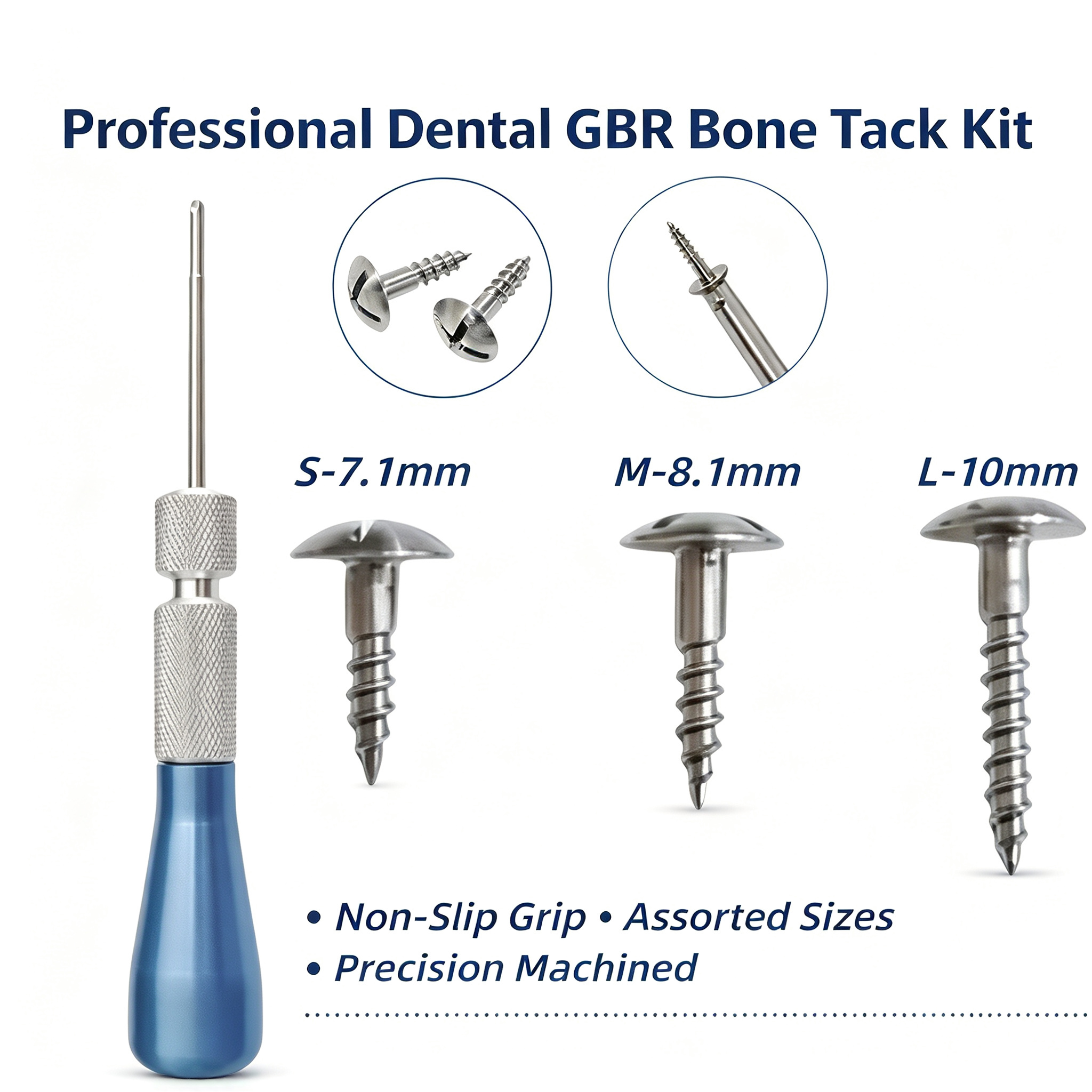
Clinics do not need complex engineering testing to reduce this risk. The most effective procurement step is to stop selecting bone tacks based solely on unit price, and instead require clear, published dimensional specifications for every tack purchased. Purpose-built GBR tacks, such as the WASSCO Dental GBR pure titanium bone tack, are manufactured from medical-grade pure titanium, supplied in sterile individual packaging, and designed with a low-profile head to minimize soft tissue irritation, with clearly documented diameter and length parameters listed on the product specification sheet for clinicians to match to their surgical technique. This level of transparency eliminates the guesswork that leads to diameter mismatch, and ensures the tack is designed specifically for barrier membrane fixation, rather than repurposed from another application. Clinics should also verify that suppliers can provide documented material and sterilization validation for the markets they serve, rather than relying on unvetted generic fasteners.
Membrane fixation is the foundational first step of every successful GBR procedure. Even the highest-quality membrane, most advanced graft material, and most skilled surgical technique cannot compensate for a tack that does not hold the barrier immobile across the full healing window. Spec-compliant titanium bone tacks are a low-cost, high-impact investment that protects clinical outcomes, reduces preventable complications, and eliminates the hidden costs that come from treating off-spec tacks as a generic commodity.